
Embodied enjoyment as a practice

In the early 2010s, my personal journey was focused on inhabiting my body joyfully and powerfully, with an emphasis on sensory awareness. That process and the skills I learned changed my life. I discovered that to be present in my body was to have access to joy and wonder, available whenever I turned my attention to it. This has remained true, even during times of illness or pain. In the decade and a half since, sensory awareness practice has become second nature.
My personal experience is the wellspring of an enduring passion and commitment to teaching embodied awareness to others. This blog explores embodied enjoyment as a powerful and readily available resource in our lives.
Defining embodiment practice
Embodiment practices are increasingly referred to by the umbrella term, ‘somatic mindfulness’, perhaps driven by common internet search terms and SEO. Somatic mindfulness literally means ‘intentional awareness of the body’. To help people understand a bit more about what that entails, I describe it as a practice of ‘noticing and experiencing the body right now from within’. This differentiates it from the awareness of the external appearance of one’s body, which is so pervasive and can be a barrier to the somatic experience of living in our bodies.
As with any form of meditation, the practice of somatic mindfulness is to notice what’s there in experience as it is happening, ideally without attachment or aversion.
Pain is our dharma. And so is joy.
The process of learning how to feel present in the body necessarily includes the arising of unexpected or difficult emotions. After all, there are reasons that many of us have histories of putting the body at a distance psychologically. Though embodied trauma has been a growing emphasis in the wellbeing space in recent years, it is not only physical and emotional pain that can surface with somatic attention. Our journeys to reconnection inevitably involve myriad feelings and sensations, including increased opportunity for enjoyment.
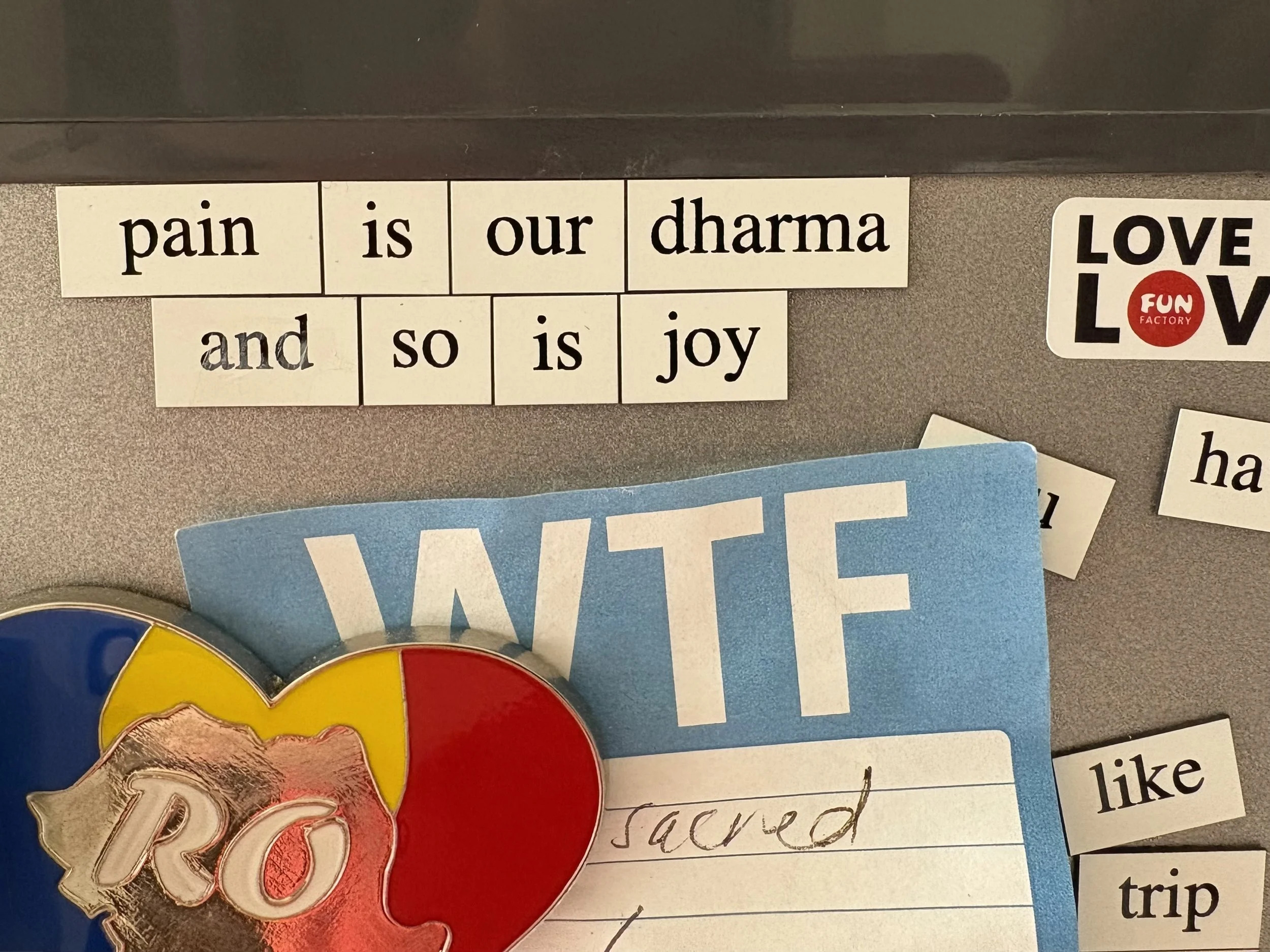
My perspective is well-summarised by a collection of words I put together from the ‘fridge poetry’ magnets on my family refrigerator. It emerged as I was contemplating the word ‘pain.’ Scanning for what might fit with it, the word ‘dharma’ drew me because one of its meanings relates to what we learn, what helps us develop. I moved the magnets into place. As I looked at the words, ‘pain is our dharma’, I felt it to be deeply true; if we allow it, we can learn a lot from pain and difficulty. Additionally, our pain deserves our attention and we do well to tend it.
But, I also felt the statement was incomplete. I hunted about the fridge door. When I spotted the word ‘joy’, I knew I had it: Joy is also our dharma. Joy can be a powerful, life-transforming teacher. Pain is our dharma. And so is joy.
Enjoyment as a therapeutic tool
Many people have an ambivalent relationship with joy. We knew it naturally as children, but circumstances, experiences and socialisation gradually limited it. As adults, most of us long for embodied joy, but we put it off. Perhaps we feel guilty or undeserving of joy, or embarrassed to show unguarded enthusiasm and spontaneity. Perhaps we’re afraid we’ll cling too much, or perhaps we just don’t know where to start. So, we default to allowing ourselves meagre pleasures, like shopping, binge-watching shows, takeout food delivered on a Friday night, drinking a bit too much or too often, to name a few. The enjoyment is usually tepid and brief, it succumbs to diminishing returns, and if a habit forms it may also do harm. It seems that deep and life-enhancing enjoyment often eludes us.
The recognition and fulsome embodying of enjoyment can therefore be a therapeutic tool. It whispers to us that we are worthy, that we belong, that we are part of something bigger than ourselves. It generates gratitude, it encourages vulnerability. It humbles us. To develop a practice of enjoyment is to cultivate a sensory part of ourselves that for some of us has long been neglected; it is a journey of re-connection.
Consider this: What’s it like to turn a corner on a chilly morning and feel the winter sun on your face and neck and experience the pleasure of it? What’s it like to hear music and be deeply moved by it, feeling that bodily? How is it to hold a hot drink in a mug and enjoy the shape and earthy texture of the warm ceramic against your palms? How is it to drink water when you’re really thirsty? What’s it like to notice during a massage how that insistent pressure into your shoulders softens the tension gorgeously or how those gliding strokes on your calves feel so good? And how is it to express that freely?
Enjoyment ‘just because’
As described above, embodied enjoyment practices can be impactful as tools in the therapeutic journey. So often beautiful experiences can move us deeply, and they can also uncover self-limiting beliefs. Doing embodied enjoyment practice in a supported environment can be tender and powerful.
However, I want to also introduce the idea that deeper work with embodied enjoyment also involves letting go of the justification of the therapeutic purpose. With increasing familiarity and readiness, it is important to explore the experience of enjoyment ‘just because’.
The World Health Organisation Constitution states: ‘Health is a state of complete physical, mental and social well-being and not merely the absence of disease or infirmity.’ I believe the ability to notice, appreciate and enjoy in an embodied way is a foundational part of that holistic wellbeing described by the WHO. I also believe it is our natural capability and right to claim – just because.
When we begin to practice noticing and enjoying pleasant and pleasurable sensations for their own sake, we can find that they are everywhere. No sensation is inconsequential. Here are three of my recent favourites:
After a long and busy day, I love getting into my bed and lying flat, knowing that rest time has arrived. Sometimes I’ll sigh at the palpable joy of this embodied moment and the gratitude I feel in experiencing it.
I thrill to an intensely intellectual conversation with dear friends. I find there is a particular physical experience when there is alignment of ideas or an ‘aha moment’ of new understanding. It’s a synergy of mind and body, like a finely tuned orchestra in absolute harmony. Whatever the descriptors, it’s more than the sum of its parts.
My little ginger cat likes to sleep on my lap. I love the way he arranges himself and flops down. The depth and volume of his purring belies the size of his tiny body. I notice his warmth, the rhythm of his breathing, and the vibrations of that loud motor of his. It is pure delight.
What examples can you think of from your experience? How would it be to notice, allow and savour them even more?
Tips for the self-practice of embodied enjoyment
When we’re learning to inhabit our bodies consciously and really notice our experience, enjoyment is a key element. Even in difficulty and pain, embodied joy is available to us. It could be as simple as noticing that you like the way it feels when you hold your breath and then exhale, or that your feet feel pleasant in these socks, or that the discomfort you experience is a little less today and the gratitude you feel about that has a sensation to it.
So, how do we cultivate embodied enjoyment? Just like meditation practice, it can be a combination of intentional time that is set aside and spontaneous moments in the course of a day. As with meditation, it is about paying attention to what is happening in the present moment. It also involves actively scanning what’s in experience for pleasant sensations to attend to and enjoy (ideally without attachment). Pleasure has been given a bad reputation; this supports us to reclaim it. Embodied enjoyment practice is a way of learning to trust pleasure – by recognising that deep enjoyment is not a liability; it is an aid to our wellbeing. So, let us not be meagre with it.
Here are four principles that can be used in the time you have. Even a few minutes spent in embodied awareness are valuable:
Take time to notice your experience within your body. This can be planned or spontaneous. Reduce interruption by switching your phone off or putting it away.
Allow yourself to attend to pleasant sensations you find – actively be with the experience. With stillness, there is always something to find, no matter how small.
Savour – don’t just notice; actively *enjoy*.
Cultivate gratitude – for being in a body, for what you can feel.
Just like other skills, embodied enjoyment capability and sensitivity grows with practice.
Postscript
There are two extraordinary writers I would like to signpost to, whose work describes joy in deeply embodied ways:
Ross Gay, an American poet, essayist, and professor of English at Indiana University. For a taster, read or listen to: Ode to Buttoning and Unbuttoning My Shirt
Andrea Gibson, an American performance poet, playwright and Poet Laureate of Colorado from 2023 until their death in 2025. For a taster, listen to: Acceptance Speech After Setting the World Record in Goosebumps
Enjoy!